Key takeaways
- Guardian Decommissioning and Wild Well Control have agreed to decommission Bullwinkle, Green Canyon 65. Well abandonment starts in Q4 2026 while Talos keeps producing; pipelines and the platform follow after production stops.
- Guardian takes operatorship as agent, first of the wells and later of the pipelines and platform. For service companies, the decommissioning programme lead is now a specialist, although the announcement does not disclose procurement authority.
- BSEE's record lists a fixed platform installed in 1988 in 1,353 feet of water, 34 wells with a decommissioning cost row, and a deterministic platform-removal estimate of about $88.5 million.
- The announced scope includes jacket reefing. Reefing changes where the jacket ends up. It does not remove the well, pipeline, topsides, severance or site-clearance work.
Most Gulf decommissioning starts after the last barrel. Bullwinkle will not.
On 7 October 2026, World Oil reported that Guardian Decommissioning and Wild Well Control had reached an agreement to decommission the Bullwinkle platform in Green Canyon Block 65. Well abandonment is scheduled to begin in the fourth quarter of 2026. The platform will still be producing when it does.
That sequence is the story. It changes how the work is planned, who controls it and who a service company should be talking to.
The platform
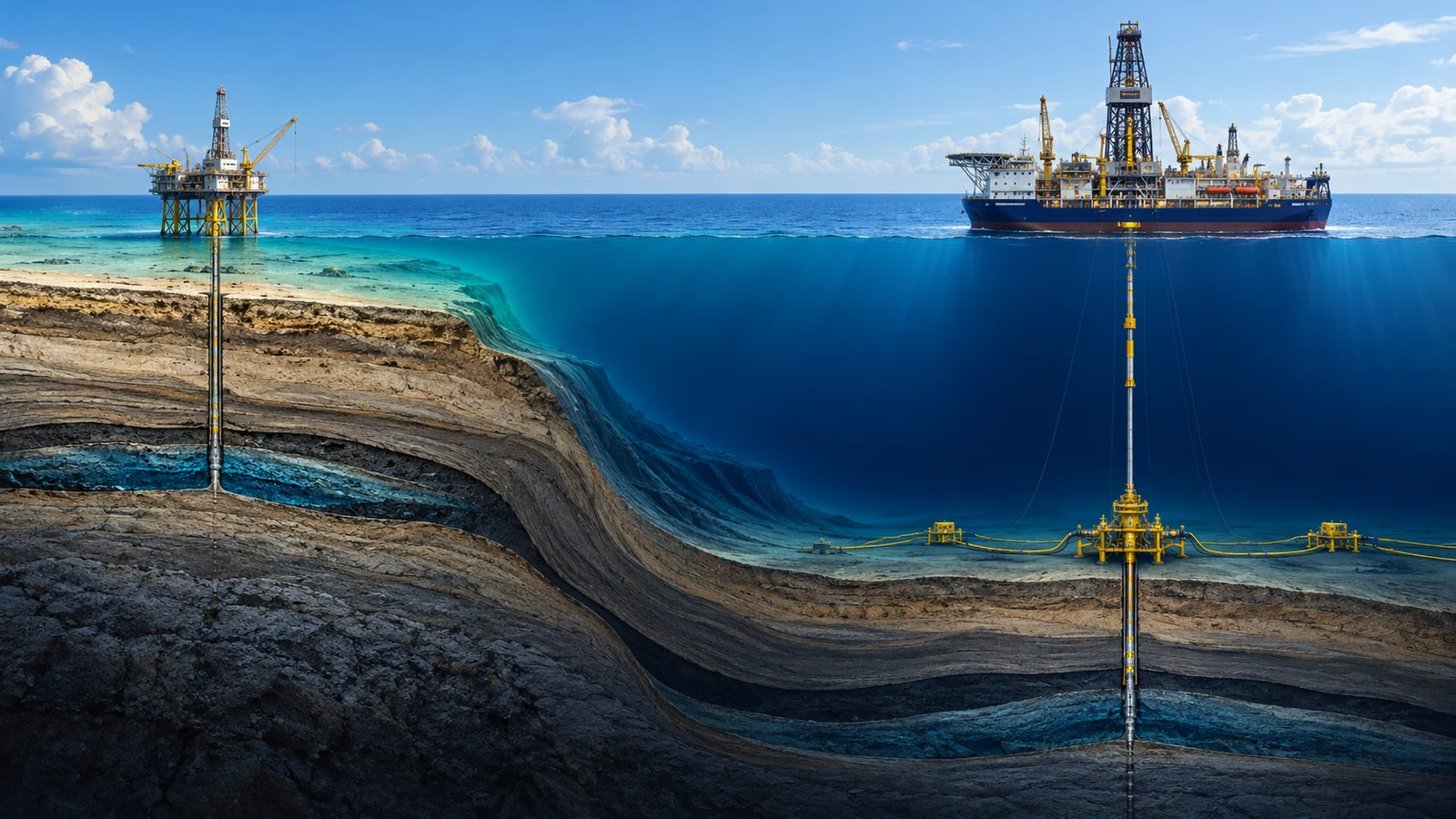
Bullwinkle is not an ordinary jacket. BSEE’s platform structure record lists structure “A (Bullwinkle)” on lease G05889 as a fixed platform, installed in 1988, in 1,353 feet of water, manned 24 hours. The removal and site-clearance date fields are empty.
Shell designed the jacket. The total structure stands 1,736 feet from the seabed to the top of the flare boom, and Offshore Technology describes it as the world’s tallest pile-supported fixed steel platform. A 1989 Offshore Technology Conference paper called it the largest steel offshore platform in the world, in the deepest water, and said it took five years to design, build and install. Treat those as claims made at the time, not a current ranking.
BSEE’s production record for the structure shows first production in July 1989. The latest month in our August 2026 snapshot is June 2026, after 432 producing months.
Bullwinkle also became a hub. Offshore Technology notes that Manatee was the fourth subsea system to use it for processing. The BSEE pipeline record still shows that role. Our August 2026 snapshot lists 20 pipeline segments touching Green Canyon 65 as active. Their facility operators include Talos, Walter Oil & Gas, Marubeni, Deepwater Abandonment Alternatives and Enbridge.
Who owns the obligation
The ownership history explains why Wild Well Control is a party to this deal.
In January 2010, Wild Well Control, a Superior Energy Services subsidiary, acquired 100% of Shell Offshore’s Bullwinkle platform and related assets, including 29 wells. It assumed the decommissioning obligation for those assets. Superior’s SEC filing records that Wild Well then conveyed an undivided 49% interest, with the matching plugging obligations, to Dynamic Offshore Resources, which operated the assets.
That 49% interest later passed to QuarterNorth Energy. BSEE’s unit exhibit for the Green Canyon 65 Unit, effective 30 November 2022, shows 100% record title held by Wild Well Control and operating rights split 51% Wild Well Control and 49% QuarterNorth. Talos announced its acquisition of QuarterNorth in January 2024. BSEE now lists Talos QN Exploration LLC as the platform’s operator. The public documents cited here establish the endpoints, not every intermediate transfer.
So the Guardian agreement is not a contractor winning a tender from a producer. It is the majority owner of the decommissioning obligation arranging for a specialist to carry it out. The report says Wild Well Control and Superior will keep their focus on well intervention and well control.
Get the next Gulf decommissioning analysis by email.
One email when a new report, case study or data feature goes live. No sales follow-up. Unsubscribe any time.
How phased abandonment alongside production works
The announced sequence has two stages.
Stage one: wells, while producing. Guardian will work with Talos and Wild Well Control to carry out well abandonment alongside ongoing production. In BSEE’s well cost data, 34 wells with Green Canyon 65 surface locations carry a decommissioning cost row. Twenty are temporarily abandoned and 14 are completed.
That split matters. Temporarily abandoned wells are not producing. They can be plugged without touching throughput. Completed wells can be plugged as they deplete. Working through the idle inventory first lets the obligation shrink while the platform still earns.
The cost is operational complexity. Plugging operations and live production share one deck, one power and utility system and one set of emergency plans. Every lift, every pressure operation and every hot-work permit has to be coordinated with a producing facility. That is simultaneous operations, and it is a discipline in its own right.
Stage two: everything else, after production. Pipeline and platform decommissioning follow once Talos ceases production. The report gives no date for that. Guardian’s later scope includes platform removal, jacket reefing, site clearance and associated insurance activities.
The pipeline record adds a complication. Bullwinkle receives lines from fields that other companies operate. Stage two depends on when production stops on the platform. It also depends on what happens to every active line that still lands there. The public record does not show how those tiebacks will be handled.
The operator-as-agent model
Under the agreement, Guardian will assume operatorship as agent of the wells, and later of the pipelines and platform, through final decommissioning.
This is a recognisable model. A specialist steps in as designated operator for the decommissioning phase only. The owners keep the underlying obligation. Under 30 CFR Part 250, Subpart Q, lessees and operating-rights owners remain jointly and severally responsible for decommissioning. An agent arrangement changes who runs the work. It does not change who is liable if it is not done.
Three things follow for anyone selling into this campaign.
First, the commercial interface has shifted. Talos remains the producing operator, while Guardian will run the decommissioning programme as operator-as-agent. The announcement does not publish the parties’ procurement authority, so it is too strong to say every purchase now sits with Guardian. Suppliers should map both relationships rather than assume the Talos route still covers the abandonment scope.
Second, two operators share one facility. During stage one, Talos runs production and Guardian runs abandonment. Interfaces, permits to work and emergency response must be agreed between them. Suppliers whose procedures assume a single operator need to check them.
Third, the scope is long. A single agent holding the wells, pipelines and platform through to clearance creates a multi-year buyer. Iain Murray, Guardian’s president, described the company as built for “multi-well campaigns and large-asset topside removals and jacket reefing”.
Bullwinkle is one campaign. A free GOMDecom account lists every tracked Gulf campaign with its operator, block, stage and regulatory stage. See the full campaign list free →
What the cost record shows
BSEE’s platform cost estimate for Bullwinkle, effective 25 February 2025, records a platform removal cost of $88,499,537. The P50, P70 and P90 columns are zero, so this is a single deterministic figure rather than the probabilistic range described in our P50, P70 and P90 explainer. The record does not say why a fixed jacket gets that treatment.
Site clearance does carry a range: $739,558 at P50, $800,260 at P70 and $903,101 at P90.
The 34 well rows each carry a deterministic figure of $759,279, about $25.8 million in total. Those well estimates date from 2016 and 2017. Treat them as an old regulatory number, not a current price.
None of these figures is a contract value. The OE report does not disclose commercial terms.
Reefing a deepwater fixed jacket
The scope names jacket reefing. It does not name a method.
Rigs-to-Reefs recognises tow-and-place, topple-in-place and partial removal, as set out in our rigs-to-reefs explainer. At 1,353 feet of water, Bullwinkle’s jacket is deeper than the 1,000 feet at Lena, the tallest structure reefed in the Gulf so far. Neither the reefing method nor the receiving state programme has been announced.
Two lessons from Lena carry over. Reefing took about four years from shut-in to toppling. And reefing removed only the tow and onshore disposal. Plugging, conductor removal, topsides removal, cleaning, severance, pipelines and site clearance all remained. Bullwinkle’s announced scope lists removal, reefing and clearance separately, which is consistent with that.
What the record does and does not show
It shows a fixed 1988 platform in 1,353 feet of water, still producing in mid-2026. It shows Wild Well Control as record title holder and majority operating-rights owner. It shows 34 wells with cost rows, an active pipeline network with several third-party operators, and a published removal estimate.
It does not show the abandonment programme, a production end date, a reefing method or contract values. Until the regulator receives permanent abandonment requests and a removal application, those stay unknown. After the July 2026 reorganisation, those filings will come through the Marine Minerals Administration, which absorbed BOEM and BSEE.
What a service company should do now
- Map the new buyer. For the wells, and later the pipelines and platform, the procurement decision sits with Guardian as operator-as-agent.
- Keep the Talos relationship for production-side work. Talos still runs the producing facility through stage one.
- Prepare a SIMOPS-ready offer. Show how your spread works on a live deck: permits, isolations, lifting plans and shared emergency response.
- Read the well list. Twenty temporarily abandoned and 14 completed wells make an idle-first sequence plausible, but the announced programme does not confirm it. Watch for permanent abandonment filings against Green Canyon 65.
- Track the tiebacks. Stage two cannot finish while active third-party lines still land on the platform. Watch each line’s status in the pipeline record.
- Qualify for the deepwater reefing scope. Severance, lifting and survey capability at around 1,350 feet will matter if the jacket is reefed in place or partly removed.
- Do not wait for the removal application. As in any pre-execution window, positioning happens before the filing appears.
The signal
Bullwinkle shows a decommissioning model the Gulf will see again. A specialist takes operatorship for the end of life. Abandonment starts before production stops. The commercial relationship moves away from the producer before the platform goes quiet.
For contractors, that means the first signal is no longer a shut-in date. It is a change of operator for the decommissioning phase. A one-off Opportunity Brief shows how GOMDecom separates those signals from a platform’s static cost estimate.
Sources
- World Oil, "Guardian to lead Bullwinkle platform decommissioning in U.S. Gulf", 7 October 2026 — agreement, operator-as-agent role, phasing, scope and the Iain Murray quote.
- Ocean News & Technology, "Guardian Decommissioning Wins Bullwinkle Platform Contract in Gulf of America" — corroborating account of the same agreement.
- Bureau of Safety and Environmental Enforcement, public datasets (platform structures, production by platform, platform, well and lease decommissioning cost estimates, lease owners, pipelines), GOMDecom snapshot of 11 August 2026 — structure type, install year, water depth, production months, cost figures, well counts and pipeline segments.
- BSEE Gulf of Mexico Region, Exhibit B, Component Leases and Ownership, Green Canyon 65 Unit (754399006), effective 30 November 2022.
- Superior Energy Services, SEC filing note, six months ended 30 June 2011 — Wild Well Control's January 2010 acquisition of Bullwinkle and 29 wells from Shell Offshore, and the 49% conveyance to Dynamic Offshore Resources.
- Journal of Petroleum Technology, report on Talos agreeing to acquire QuarterNorth for $1.29 billion, January 2024.
- Offshore Technology, Manatee project profile — Bullwinkle height, record claim and hub role.
- Transport Research International Documentation, "The Bullwinkle Project: An Overview", Offshore Technology Conference, 1989 — water depth and contemporary record claims.
- U.S. Department of the Interior, Secretary's Order No. 3451, "Establishment of the Marine Minerals Administration", 10 July 2026.
- Electronic Code of Federal Regulations, 30 CFR Part 250, Subpart Q — Decommissioning Activities.
Put this to work
Track the opportunities behind the analysis.
Gulf decommissioning opportunities identified in monitored BSEE records, ranked by commercial priority and refreshed daily. Or validate a single pursuit with a $19 brief.
GOMDecom aggregates public regulatory data for informational purposes. Figures quoted from third parties are attributed in the text; verify against the cited source before acting. Nothing here is legal, investment or procurement advice.