Key takeaways
- A sales window is a commercial interpretation of regulatory evidence, not a BSEE status and not proof that procurement is open.
- Scout is for early account development; Engage is for credible activity without a confirmed filing; Bid/verify is for filed or scheduled work where procurement must be checked; Execution is for remaining or follow-on scope around an active campaign.
- The window differs by service. The same campaign can be late for well P&A but early for structure removal, pipeline work or site clearance.
- The strongest action is evidence-specific: know which record changed, what remains observable, which milestone comes next and what the record cannot tell you before making contact.
“Is it too early?” and “Are we already too late?” are the two questions underneath most decommissioning prospecting. A list of idle wells does not answer them. Neither does a removal application by itself. Timing comes from the position of a campaign in the regulatory sequence—and even then, the answer can differ by service line.
GOMDecom describes that position as a sales window: Scout, Engage, Bid/verify, Execution or Closed. These are not labels used by BSEE. They are contractor-facing judgments derived from the evidence BSEE publishes. Their purpose is to turn a signal into a proportionate next action without pretending that public records reveal private procurement.
Start with the regulatory sequence
The observable sequence usually runs from early context toward physical completion:
ownership or production change → idle scope → filing → approval or accepted permit → scheduled activity → work commenced → completion record
Not every asset follows every step, and records can arrive late. But the sequence gives a commercial team a common language. The existing signal-chain guide explains the underlying datasets; the question here is what a seller should do at each point.
| Window | What the record generally shows | Proportionate commercial action | Never assume |
|---|---|---|---|
| Scout | Early ownership, production, idle or obligation signals | Map the account, build relationships, verify asset relevance | A project or budget exists |
| Engage | Credible remaining scope plus movement, but no decisive work filing | Share capability, availability or comparable experience; ask a narrow question | A tender is imminent |
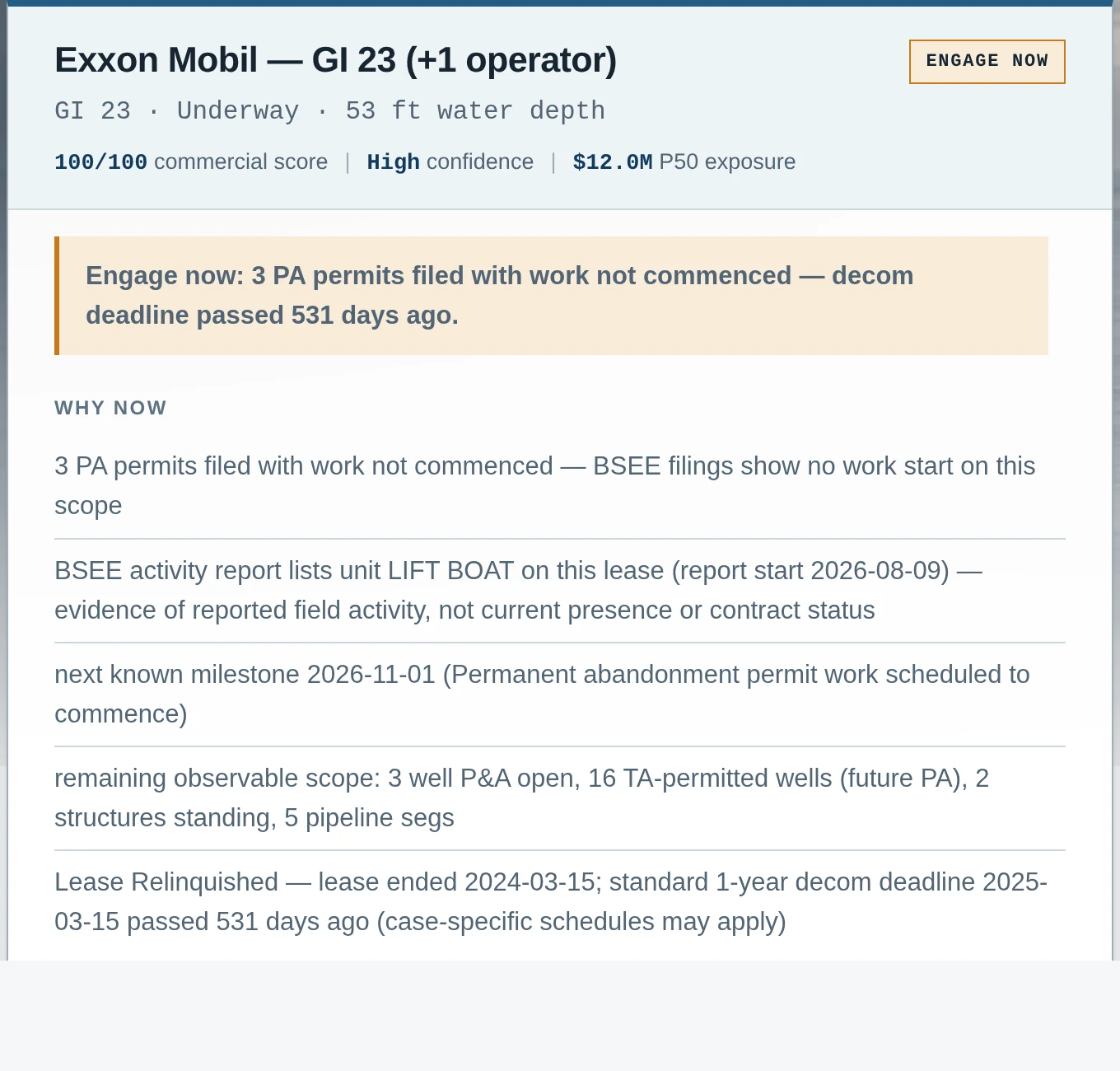
| Bid/verify | Filing, approval or scheduled activity with no observed commencement for that scope | Verify procurement immediately and qualify the package | The work is unawarded |
| Execution | Work commencement is recorded | Investigate remaining phases, adjacent assets and follow-on services | The entire campaign is closed |
| Closed | Completion is observed for the relevant scope | Stop pursuing that item; retain account context | Every related lease obligation is complete |
The phrase Bid/verify is deliberately two-part. A filed or scheduled activity can justify urgent investigation, but urgency is not evidence of an open bid. The operator may have procured the work before the filing appeared.
Scout: build context before the project is visible
Scout is the earliest window. It can be created by an assignment, production cessation, an aging idle-well inventory, a lease clock or another change that increases the probability that decommissioning will matter. There is no specific execution filing yet.
This is account-development territory. A strong Scout action is not “we saw your tender.” It is a useful, low-pressure exchange: confirming who owns the asset plan, sharing a relevant campaign lesson or making sure the right technical capability is known before the schedule hardens.
The Gulf campaign snapshot documented in our operator-exposure analysis contained 162 early campaigns. That is too many to pursue indiscriminately. Rank them by fit: geography, water depth, asset type, operator relationship, service match and whether several early signals point in the same direction.
Scout means earn the right to be remembered. It does not mean manufacture urgency from an idle asset count.
Engage: movement creates a reason to call
Engage sits between a cold watchlist and a permit-driven pursuit. GOMDecom uses it where remaining scope and recent evidence make a commercial conversation timely, even though the record does not yet support a stronger Bid/verify judgment for that service.
The message should name the evidence without overclaiming it. “We are seeing movement around your South Marsh Island portfolio and have a lift spread available in Q4” is better than “we know this project is going out.” One is relevant account intelligence; the other asserts a procurement fact the public record does not contain.
Engage is particularly important for structure work. In that campaign view, 134 non-completed campaigns sat in an Engage window for structures, covering 344 standing structures. Many had no open removal application in the tracked record. They were not bid-stage opportunities; they were accounts where scope and surrounding movement justified earlier qualification.
Bid/verify: the narrowest pre-execution window
Bid/verify is reserved for stronger evidence: a relevant filing, approval, accepted permit or scheduled start without observed commencement for that item. In the same dataset, 73 campaigns sat in this structure window, covering 257 standing structures and 127 open removal applications. For wells, only four campaigns occupied the comparable Bid window.
At this stage, speed matters—but precision matters more. Before escalating internally, answer four questions:
- Which exact filing or date changed?
- Which scope remains observable after completed items are removed?
- Is the company a credible supplier for the water depth, method and package size?
- Has procurement status been checked through the account?
If the fourth answer is unknown, the pursuit is not qualified. “No work commencement observed” is a regulatory statement. It is not “no contract awarded.”
Execution: late for one service can be early for another
Execution is often discarded too quickly. A commencement record proves that some work is underway, but offshore decommissioning is sequenced. Wells can move before topsides; topsides can move before jackets; pipelines and site clearance can trail both. Multi-lease programs can roll from one block to the next.
The campaign view carried 193 campaigns in an overall Execution stage. For the well-service window, 176 were classified as Execution. That is a poor list for selling the exact P&A task already underway, but it may be a valuable list for:
- remaining wells on the same lease;
- structure preparation and removal;
- marine support and logistics;
- pipeline flushing, cutting or abandonment;
- ROV inspection and site-clearance work;
- adjacent campaigns where an operator or prime contractor already has a spread mobilized.
This is why GOMDecom maintains separate well and structure windows. A single campaign-level label cannot express every service’s timing.
Closed: stop spending pursuit time
Closed is a scope decision, not a relationship decision. When the record confirms permanent abandonment, removal or other completion for the item being evaluated, that item should leave the active pursuit list.
The discipline matters because old opportunities are comforting. They have familiar operator names, visible records and internal notes. Without a completion rule, they remain in a CRM long after the sellable scope has disappeared.
Closed does not mean the operator has no other work. It means the evidence no longer supports pursuit of that particular scope. Move the account relationship forward; remove the dead line item.
A five-minute qualification before contact
Before turning any signal into outreach, make the opportunity pass a short test:
- Fit: does the remaining observable scope match what we actually sell?
- Evidence: can we name and link the source change?
- Window: is the action Scout, Engage, Bid/verify or Execution for our service?
- Timing: is there a real date, a standard regulatory clock or only an inference?
- Ownership: who appears responsible now, and does predecessor history matter?
- Procurement: what do we know from the account that BSEE cannot tell us?
- Next action: is there one useful question or offer we can make today?
If the opportunity fails the fit or evidence test, do not dress it up with a high-level market statistic. If it passes those tests but procurement is unknown, investigate rather than forecast.
What the window cannot promise
A sales window is intentionally narrower than a prediction. It cannot confirm an unawarded contract, identify the selected contractor, reveal the operator’s budget or guarantee that a scheduled date will hold. Filings can lag commercial decisions, and case-specific extensions can move regulatory timing.
What it can do is enforce consistent behavior: start relationships early, increase urgency when the evidence strengthens, look for follow-on scope during execution and close work that the record shows is done. That is a more useful operating system than treating every BSEE row as either “lead” or “not a lead.”
See the full evidence-to-action judgment in a sample Opportunity Brief, or use Radar to apply the same windows across every tracked Gulf campaign.
Sources
- Bureau of Safety and Environmental Enforcement, Data Center, including eWell APM/EOR, borehole, platform, pipeline, assignment and production records.
- GOMDecom, Gulf campaign snapshot documented in the operator-exposure analysis: lifecycle and well/structure sales-window classifications.
- GOMDecom, methodology: lifecycle stages, commercial score, confidence and sales window.
- GOMDecom, the decommissioning signal chain: how BSEE filings reveal work before execution.
Put this to work
Track the opportunities behind the analysis.
Gulf decommissioning opportunities identified in monitored BSEE records, ranked by commercial priority and refreshed daily. Or validate a single pursuit with a $19 brief.
GOMDecom aggregates public regulatory data for informational purposes. Figures quoted from third parties are attributed in the text; verify against the cited source before acting. Nothing here is legal, investment or procurement advice.