Key takeaways
- The Gulf campaign snapshot used for this analysis associates 1,304 pipeline segments with 420 campaigns not marked completed. A segment is a regulatory and data unit, not necessarily a standalone work package.
- Green Canyon leads the area rollup with 175 segments, followed by Mississippi Canyon with 164, Main Pass with 153, South Timbalier with 142 and South Marsh Island with 106. Deepwater and shelf concentrations imply different methods and supplier fits.
- A DOI pipeline out of service for five or more years must be decommissioned under 30 CFR 250.1750–250.1754. BSEE may allow decommissioning in place where the line will not create navigational, fishing, OCS-use or environmental problems.
- Commercial qualification requires status, length, diameter, product, endpoints, method, connected-facility sequence and permit timing—not just a segment total.
Decommissioning stories end too often when the platform leaves the water. The pipeline network remains on the seabed.
In the Gulf campaign snapshot documented in our operator-exposure analysis, 1,304 pipeline segments are associated with 420 tracked campaigns not marked completed. They connect mature shelf platforms, deepwater facilities, lease blocks and rights-of-way across the Gulf. Some may be decommissioned in place. Some may require removal. Some may already be out of service but not yet carry the completion evidence used in the campaign view.
The number is large enough to deserve its own commercial analysis—and too easy to misuse as “1,304 jobs.”
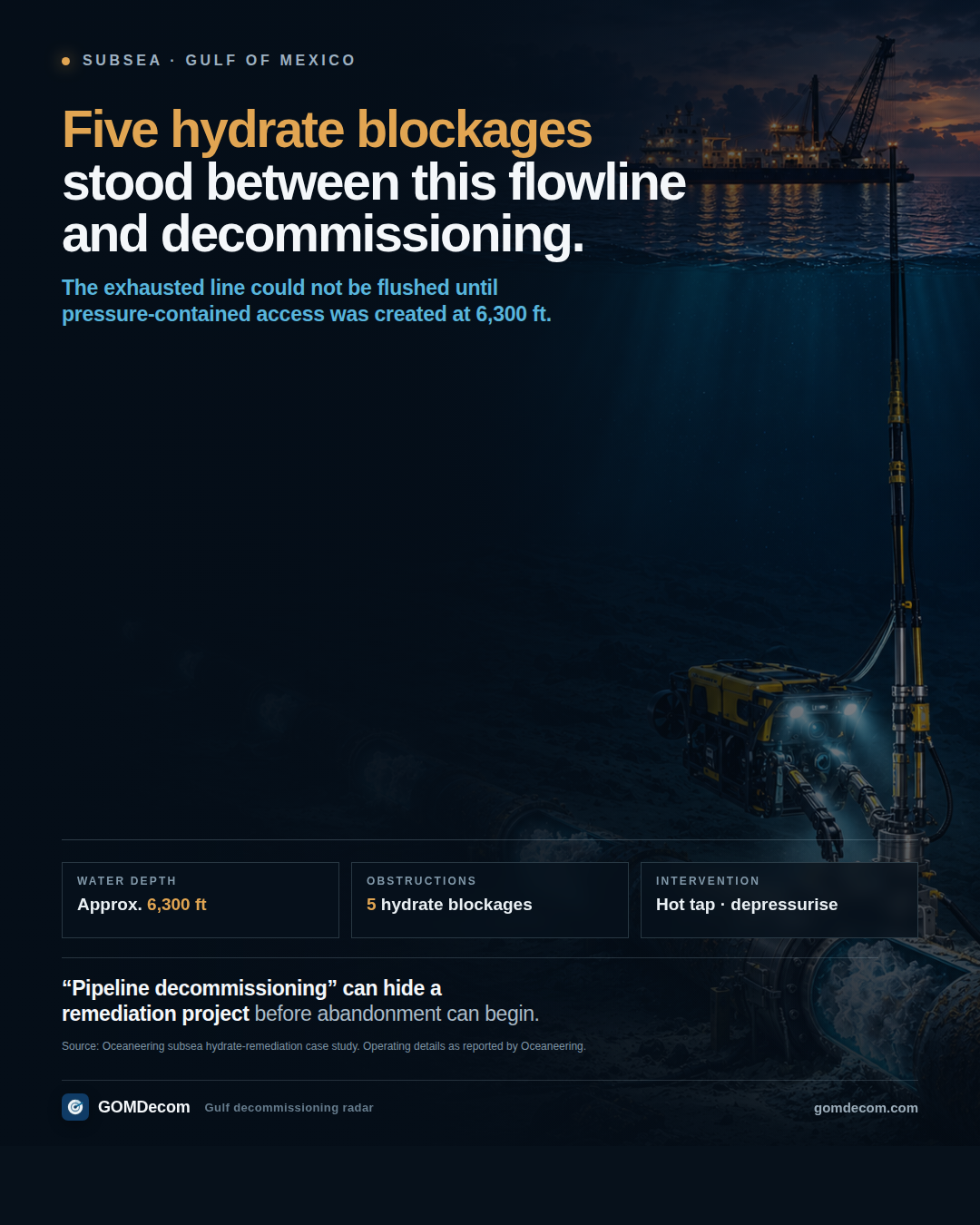
A pipeline record can hide substantial precursor work. Source: Oceaneering subsea hydrate-remediation case study; operating details as reported by Oceaneering.
What a pipeline segment represents
BSEE’s Pipeline Information describes each segment by a segment number and publishes attributes including origin and destination, operator, approval authority, size, product codes, dates and location. A segment is therefore a traceable regulatory and physical record.
It is not automatically a procurement package. An operator may combine several connected segments into one decommissioning application or marine campaign. A long segment can represent more work than several short jumpers. A line left in place has a different method and vessel requirement from a line removed. Appurtenances, crossings, burial, water depth and contamination history also matter.
GOMDecom groups pipeline segments with the wells, structures, leases and operators around a campaign so the line is not read in isolation. The 1,304 count is the sum of pipeline-to-decommission segment records in campaigns whose overall status was not Completed in the underlying campaign snapshot.
Segment count shows network complexity. It does not price cleaning, cutting, burial, recovery or survey work.
Where the pipeline tail is concentrated
The leading areas differ from the standing-platform ranking, which is a useful clue about service mix.
| Gulf area | Pipeline segments in non-completed campaigns |
|---|---|
| Green Canyon (GC) | 175 |
| Mississippi Canyon (MC) | 164 |
| Main Pass (MP) | 153 |
| South Timbalier (ST) | 142 |
| South Marsh Island (SM) | 106 |
Green Canyon and Mississippi Canyon bring deepwater infrastructure, subsea tiebacks and longer marine spreads into the ranking. Main Pass, South Timbalier and South Marsh Island contain dense shelf infrastructure with different access, burial and facility relationships. A supplier looking only at platform counts would miss that split.
The practical account question is not just “where are the lines?” It is “which connected facilities are moving, and does that movement create a pipeline phase we can serve?”
The out-of-service clock
30 CFR 250.1006 sets escalating requirements for DOI pipelines taken out of service:
- for one year or less, isolate the line with a blind flange or closed block valve at each end;
- for more than one but less than five years, flush and fill it with inhibited seawater; and
- for five years or more, decommission it under §§250.1750 through 250.1754.
As with Idle Iron wells, this standard clock is useful for screening but does not disclose the procurement schedule. The actual record can include approvals, extensions, connected-facility dependencies and operator-specific plans.
The commercial signal strengthens when an out-of-service history is joined by a decommissioning application, recent permit activity or execution on the wells and facilities at either end.
In place does not mean ignored
Pipeline decommissioning is often an in-place operation. Under 30 CFR 250.1750, the Regional Supervisor may allow a pipeline to be decommissioned in place where it will not constitute a hazard to navigation or commercial fishing, unduly interfere with other OCS uses or have adverse environmental effects.
Section 250.1751 still requires an approved application and a defined operation. The operator generally must pig the pipeline unless BSEE determines that is impractical, flush it, fill it with seawater, cut and plug each end, bury or protect the ends where required, and remove valves or fittings that would interfere with other OCS uses.
Within 30 days after decommissioning, §250.1753 requires a written report stating when the operation was completed, describing mitigation and certifying that the approved operation was followed.
That sequence creates multiple contractor scopes even when no steel comes to shore:
- engineering and application support;
- isolation, pigging, flushing and fluid handling;
- diving or ROV intervention;
- subsea cutting, plugging and end burial;
- mattress or protective-cover placement;
- debris and obstruction removal; and
- post-work survey and completion documentation.
When removal is required
30 CFR 250.1752 governs removal where the Regional Supervisor requires it. Removal introduces a different chain: disconnecting the line, clearing hydrocarbons, recovering pipe or sections, handling shore disposal and documenting the cleared route or ends.
The method cannot be inferred safely from the status field alone. A line marked for decommissioning may be a candidate for in-place treatment, partial recovery around crossings or full removal. The approved application and connected-facility plan are the deciding evidence.
Why pipelines trail wells and structures
Pipelines are connected assets. Their decommissioning often depends on production cessation, well isolation, platform work and the future use of shared infrastructure. A line cannot be treated as redundant merely because one lease stops producing if it still serves another facility or remains necessary for an approved plan.
That dependency can make the pipeline phase commercially later than P&A and structure preparation. It also creates bundling opportunities:
- a vessel mobilized for structure work may support cutting or survey;
- an ROV spread inspecting wells can verify pipeline condition;
- several adjacent segments can move under one cleaning and abandonment program; and
- site-clearance work can combine structure footprints, well sites and pipeline ends.
The public-data challenge is to identify those relationships without claiming a package that the operator has not disclosed. Campaign grouping is a hypothesis to investigate, not a substitute for the operator’s execution plan.
A pipeline qualification stack
Before treating a segment as addressable scope, resolve:
- Status: active, out of service, abandoned or associated with a decommissioning permit?
- Geometry: length, diameter, endpoints, water depth and crossings?
- Product and condition: what was transported, and what cleaning or integrity work may be required?
- Method: in-place decommissioning, partial recovery or removal?
- Dependencies: which wells, platforms or other lines have to move first?
- Timing: is there an application, approval, completion deadline or recent change?
- Packaging: one segment, one network, or part of a larger campaign?
- Procurement: has the account confirmed what the regulatory record cannot?
The 1,304-segment headline identifies a material market tail. The qualified pursuit emerges only after those questions reduce the count to a service-compatible, timed and verifiable campaign.
For pipeline, subsea, ROV and marine contractors, that is precisely where a one-off Opportunity Brief earns its keep: not by repeating a segment number, but by showing the connected operator, facilities, remaining observable scope, timing and evidence in one place.
Sources
- GOMDecom, Gulf campaign snapshot documented in the operator-exposure analysis: campaign, pipeline-segment and area rollups.
- Bureau of Safety and Environmental Enforcement, Pipeline Information, including pipeline locations, permits, histories and segment reports.
- Electronic Code of Federal Regulations, 30 CFR 250.1006 — Pipelines out of service.
- Electronic Code of Federal Regulations, 30 CFR Part 250, Subpart Q, especially §§250.1750–250.1754.
Put this to work
Track the opportunities behind the analysis.
Gulf decommissioning opportunities identified in monitored BSEE records, ranked by commercial priority and refreshed daily. Or validate a single pursuit with a $19 brief.
GOMDecom aggregates public regulatory data for informational purposes. Figures quoted from third parties are attributed in the text; verify against the cited source before acting. Nothing here is legal, investment or procurement advice.