Key takeaways
- 30 CFR 250.1715 prescribes outcomes — plug placement, 100-foot and 150-foot cement intervals, and a defined integrity test — not the equipment used to achieve them.
- Plug integrity must be proven by either 15,000 pounds of pipe weight on the plug, or 1,000 psi pump pressure with no more than a 10 percent drop in 15 minutes.
- Rigless and riserless approaches exist to avoid mobilising a jackup or platform rig. One published Gulf case reports riserless coiled tubing wellbore access cutting operating time by up to 40 percent against riserless workover rig operations.
- Well condition decides method, and method decides which contractors can compete. A well count is not an addressable market until it is split by method.
Read 30 CFR 250.1715 carefully and you will notice something the regulation does not do. It never specifies what equipment you must use.
It specifies results. Cement plugs isolating oil, gas and fresh-water zones, extending at least 100 feet below the bottom and 100 feet above the top of those zones. A cement surface plug at least 150 feet long in the smallest casing extending to the mud line, set no more than 150 feet below the mud line. Specific alternatives for open hole below casing, perforated intervals and casing stubs — cement plugs set by displacement, cement retainers with back-pressure control, bridge plugs with cement on top.
And a test. The plug must pass one of two: minimum 15,000 pounds of pipe weight set on the plug, or minimum 1,000 psi pump pressure with no more than a 10 percent pressure drop in 15 minutes.
Nothing in that list is a vessel. The regulator cares whether the barrier exists and holds. How it got there is an engineering and commercial decision — and it is the decision that determines which companies are even allowed to quote.
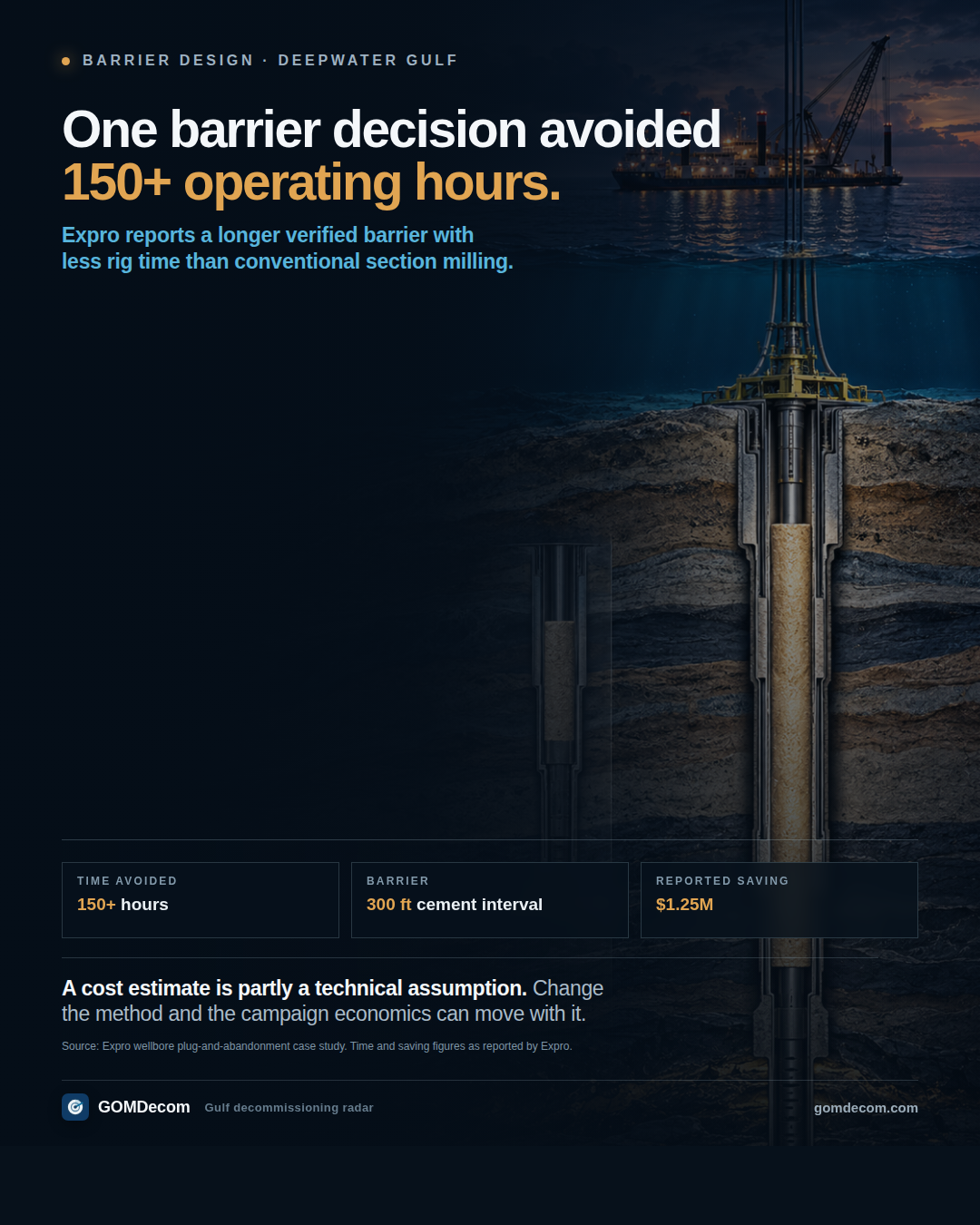
Source: Expro wellbore plug-and-abandonment case study. Time and saving figures are reported by Expro for that campaign, not a universal benchmark.
What “rigless” actually means
Rigless is defined by absence. It means performing abandonment without mobilising a jackup rig or a full platform rig.
The economic argument is straightforward. Mobilising a jackup for a shallow-water well abandonment carries a mobilisation cost, a day rate and a scheduling constraint that can dwarf the work itself. Rigless intervention systems are designed to complete tasks normally performed by a jackup or workover unit at lower cost.
The practical forms vary:
- Platform rig. Where a drilling rig remains on the structure, it is often the cheapest path — but on a decommissioning candidate it usually left years ago.
- Jackup or workover rig. Full capability, full cost, full mobilisation.
- Lift boat with a pulling and jacking unit. An integrated system jacked up alongside or over the wellhead, doing hoisting work without a rig.
- Coiled tubing. Widely used for well plugging where a rig is not needed, including in deep high-pressure, high-temperature Gulf wells.
- Riserless intervention from a vessel. Deepwater and subsea wells accessed without a riser, which removes the largest single piece of the conventional spread.
- Light well intervention vessels. The subsea end of the same logic.
One published Gulf case study on deepwater riserless coiled tubing operations reports that riserless wellbore access with coiled tubing reduced operating time by up to 40 percent compared with riserless workover rig-based operations. Treat that as a documented project result rather than a universal rule — but the direction is consistent across the literature.
The regulation sets the barrier standard. The well’s condition sets the method. The method sets the bidder list.
What decides whether a well can go rigless
This is the part that cannot be read off a well count, and it is where most market sizing fails.
Can the tubing stay? Many rigless approaches depend on not having to pull the completion. If tubing, packers and downhole equipment must come out, hoisting capacity and pipe handling become the constraint, and the job trends toward a rig or a jacking unit.
Is there sustained casing pressure? Annular pressure, failed cement behind casing or an uncertain barrier history add scope that lighter spreads may not be able to resolve.
What is the casing architecture? Section 250.1715 treats open hole, open hole below casing, unsqueezed perforated zones and casing stubs differently. A well with multiple strings and stubs to isolate is a more complex barrier problem than a single-string producer.
Is it a subsea well? The regulation adds requirements for subsea wells, including severing casing and plugging the stub. That is a different operation from a dry-tree shelf well, and a different contractor set.
Was it temporarily abandoned, and when? A well in temporary abandonment carries barriers that were never intended to be permanent. We examined that distinction in temporarily abandoned is not permanently abandoned. A long-standing TA with uncertain barrier condition is a poor rigless candidate until it has been diagnosed.
Can the integrity test be met? Both test options in §250.1715 require real capability. The 15,000-pound pipe weight option needs hoisting and a tubular string. The 1,000 psi option needs controlled pumping and 15 minutes of stable observation. A spread that cannot demonstrate one of these cannot complete the plug, whatever else it can do.
Are barriers already removed? The regulation requires two independent barriers, one of them mechanical, in the centre wellbore where barriers have been removed. That requirement shapes the plugging programme before any equipment is chosen.
Get new explainers on Gulf decommissioning rules and data by email.
One email when a new report, case study or data feature goes live. No sales follow-up. Unsubscribe any time.
Why this matters commercially
Our open wells analysis found 1,813 open wells in the Gulf, with only a fraction inside a pre-execution sales window. That headline is useful for scale and useless for targeting, because it is undifferentiated by method.
Split the same inventory by method and it becomes three or four different markets with almost no overlapping bidder lists:
| Method | Who competes | What it hinges on |
|---|---|---|
| Platform rig | Rig contractor already on site | Rig still present |
| Jackup / workover rig | Rig contractors, shelf | Pulling the completion, complex barriers |
| Lift boat + pulling and jacking unit | Lift boat operators, well service | Shallow water, moderate hoisting |
| Coiled tubing, rigless | CT and intervention specialists | Through-tubing access, no pull required |
| Riserless / light well intervention | Vessel-based intervention | Subsea, deepwater |
A coiled tubing company and a jackup contractor are not competing for the same well. They are competing to have the well’s condition classified in a way that favours them — which is a technical argument made with diagnostic data, not a price argument.
That is also why “1,813 open wells” should never appear in a pitch without a method filter behind it. The relevant number is always smaller and always more specific.
The cost argument, stated honestly
Rigless is cheaper when it works. The savings are real: no rig mobilisation, a smaller spread, shorter mobilisation lead time, often a smaller crew and lower emissions.
Rigless is more expensive when it fails. A rigless attempt that cannot establish or test a barrier, discovers unexpected pressure, or cannot access the wellbore ends with a demobilisation and a rig mobilisation anyway — paying for both. The cheap option became the expensive one because the well was classified optimistically.
This is the same estimate-versus-actual asymmetry that runs through decommissioning cost work generally, and it argues for spending money on diagnosis before spending it on method selection. A logging or integrity run that de-risks the method choice is usually cheaper than the failed attempt it prevents.
For the regulator’s part, the method choice is not the submission. The District Manager may require additional well plugs as necessary, which means the approved programme — not the equipment list — is the governing document.
A method qualification stack
Before treating a well as addressable for your spread, resolve:
- Well type. Dry tree or subsea? Single or multiple strings? Casing stubs to isolate?
- Completion status. Must the tubing and packer be pulled, or is through-tubing access viable?
- Barrier history. Known cement quality, annular pressure, previous TA plugs, any barriers already removed?
- Zones to isolate. How many hydrocarbon and fresh-water zones, and at what depths? This sets cement volumes under §250.1715.
- Test route. Which of the two integrity tests will be used, and can the proposed spread perform it?
- Water depth and access. Lift boat capable, jackup required, or vessel-based?
- Campaign adjacency. How many wells of the same class are within one mobilisation?
- Programme status. Is there an approved plugging programme, or only an intention?
The point to hold on to
Decommissioning markets are usually described in counts: wells, structures, segments, dollars. Those counts are the denominator, not the opportunity.
The regulation’s silence on equipment is what creates the opportunity. Because §250.1715 prescribes outcomes rather than methods, the same obligation can be discharged several ways at materially different costs by materially different companies. Winning the work means being the method the well’s condition actually supports — and proving it with diagnostics before the operator has settled on a spread.
Getting from a well count to a method-qualified, timed target list is the work. It is what a one-off Opportunity Brief is built to deliver for a single account.
Sources
- 30 CFR 250.1715 — How must I permanently plug a well?, including the plugging requirement table, the 150-foot surface plug, subsea casing severance, the two-independent-barrier requirement, and the 15,000-pound and 1,000 psi integrity tests.
- Electronic Code of Federal Regulations, 30 CFR Part 250, Subpart Q — Decommissioning Activities.
- Society of Petroleum Engineers, "Deepwater Riserless Operations with Coiled Tubing in the Gulf of Mexico: An Innovative, Safe, and Efficient Plug-and-Abandonment Technique" — the reported reduction in operating time against riserless workover rig operations.
- Society of Petroleum Engineers, "Plug and Abandonment of a Deep High-Pressure and High-Temperature Gulf of Mexico Well Using Coiled Tubing: A Case History".
- Offshore Engineer, "Going rigless" — on rigless intervention systems designed to perform tasks normally done by a jackup or workover unit.
- GOMDecom, open wells and pre-execution sales windows, for the Gulf open-well count referenced above.
Put this to work
Track the opportunities behind the analysis.
Gulf decommissioning opportunities identified in monitored BSEE records, ranked by commercial priority and refreshed daily. Or validate a single pursuit with a $19 brief.
GOMDecom aggregates public regulatory data for informational purposes. Figures quoted from third parties are attributed in the text; verify against the cited source before acting. Nothing here is legal, investment or procurement advice.