Key takeaways
- W&T Offshore's reported asset retirement obligation grew from $310.1 million at the end of 2018 to $561.9 million at the end of 2025, an increase of about 81 percent.
- Talos Energy's grew from $541.7 million at the end of 2022 to $1,332.1 million at the end of 2025, an increase of about 146 percent, with acquisitions a major driver.
- ARO rises even when work is completed, because accretion, upward revisions and acquired liabilities routinely outpace settlements.
- ARO is a discounted accounting estimate on a specific measurement date. It is not a cash forecast, not a schedule, and not the same figure as a regulator's P50 cost estimate.
There is one number in a Gulf operator’s annual report that tells a contractor something useful about the size of its decommissioning obligation. It is also one of the most reliably misread numbers in the filing.
The asset retirement obligation — ARO — is the discounted present value of the cost the company expects to incur to retire its assets. For an offshore operator, that is plugging, removal, pipeline decommissioning and site clearance.
Here is what it has done at two Gulf-focused operators, as tagged in their annual filings.
Two series worth keeping
W&T Offshore
| Year end | Reported ARO | Change |
|---|---|---|
| 2018 | $310.1m | — |
| 2019 | $355.6m | +14.7% |
| 2020 | $392.7m | +10.4% |
| 2021 | $424.5m | +8.1% |
| 2022 | $466.4m | +9.9% |
| 2023 | $498.8m | +6.9% |
| 2024 | $548.8m | +10.0% |
| 2025 | $561.9m | +2.4% |
Seven consecutive annual increases. Total growth of about 81 percent.
Talos Energy
| Year end | Reported ARO | Change |
|---|---|---|
| 2022 | $541.7m | — |
| 2023 | $897.2m | +65.6% |
| 2024 | $1,149.7m | +28.1% |
| 2025 | $1,332.1m | +15.9% |
Growth of about 146 percent in three years, crossing a billion dollars in 2024.
Kosmos Energy, by contrast, shows that the line can fall: $302.5m (2022), $346.8m (2023), $407.0m (2024), then $337.5m (2025) — a 17 percent decrease in the final year. Kosmos holds significant non-Gulf assets, so this series illustrates direction and mechanism rather than Gulf scope.
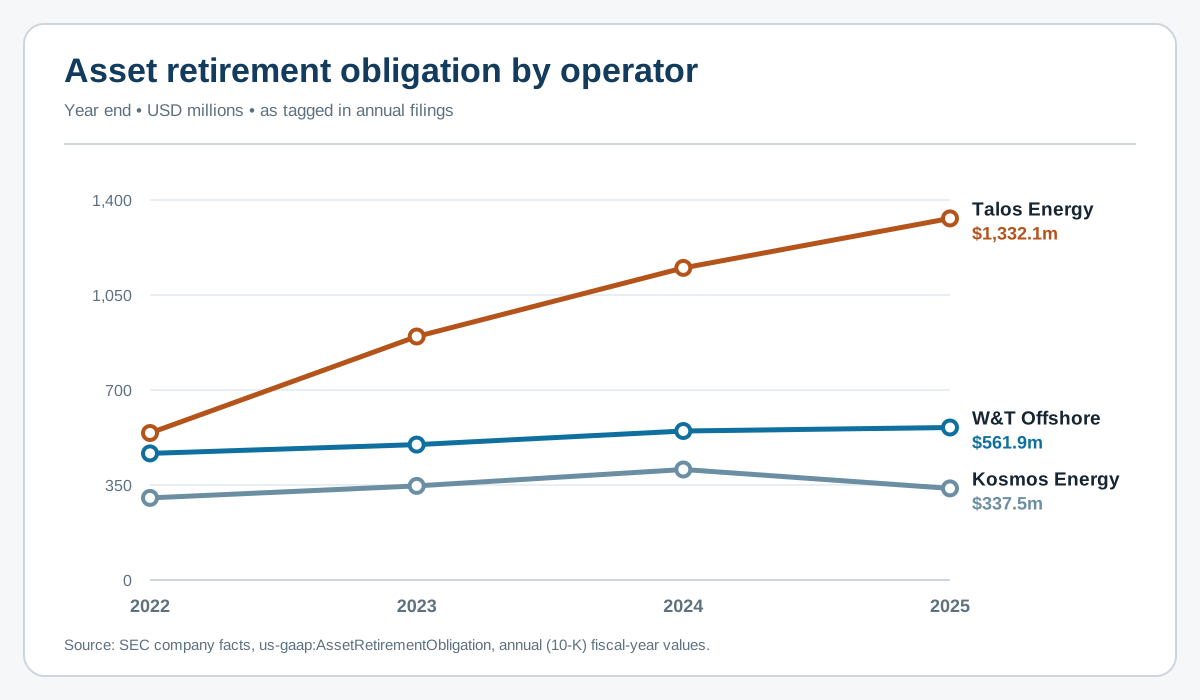
Decommissioning work was performed in every one of these years. The liability still rose at both Gulf operators. That is not a contradiction. It is how the accounting works.
Why ARO rises while work gets done
Four movements run through the ARO reconciliation each year, and only one of them reduces the balance.
Accretion. ARO is recorded at discounted present value. Every year that passes unwinds some of that discount, so the liability grows mechanically as the settlement date approaches. No work and no cost change is required. On a large mature portfolio, accretion alone can be tens of millions a year.
Revisions. Cost estimates get updated. Day rates, vessel availability, scope discovery, well condition and regulatory expectation all push estimates around, and the revisions have been predominantly upward across the industry. A well that turns out to need a rig rather than a rigless intervention is a revision.
Liabilities incurred and acquired. New wells and facilities add obligations. So do acquisitions — and this is the dominant driver in the Talos series, which spans the period of its $1.3 billion QuarterNorth Energy acquisition announced in January 2024. Buying Gulf production means buying Gulf decommissioning.
Settlements. Work actually performed and paid for reduces the balance. This is the only line that moves it down, and at these operators it has not been large enough to offset the other three.
So a rising ARO does not mean an operator is neglecting its obligations. A falling ARO does not necessarily mean an operator is discharging them — it can equally reflect a divestment, a downward revision or a discount-rate change.
Get the next Gulf decommissioning analysis by email.
One email when a new report, case study or data feature goes live. No sales follow-up. Unsubscribe any time.
What ARO is not
This is where commercial mistakes get made.
It is not a cash number. ARO is discounted. The undiscounted cost is higher, often materially, and it is the undiscounted figure that resembles what a contractor would invoice. Many filings disclose both; read the note, not the balance sheet line.
It is not a schedule. ARO tells you the present value of the total. It does not tell you how much falls in the next 12 months, which structures are involved, or whether anything is permitted. The current-versus-noncurrent split in the filing is the nearest thing to timing information, and it is coarse.
It is not the regulator’s number. A company’s ARO and a regulator’s decommissioning cost estimate are built for different purposes on different assumptions. We set out the mechanics of the agency side in P50 versus P70 versus P90. A probabilistic regulatory estimate and a GAAP accounting estimate will not agree, and neither is wrong for disagreeing.
It is not a measure of addressable scope. Our own operator exposure analysis counts campaigns, wells, structures and segments. ARO counts dollars of discounted liability across a company’s whole portfolio, including assets outside the Gulf. The two views answer different questions.
It is not comparable across companies without care. Discount rates differ. Portfolio mix differs. The tagged concept in a filing may be the total or only the non-current portion. Compare a company with itself over time before comparing it with a peer.
What a contractor can legitimately read from it
Used carefully, ARO is one of the few forward-looking disclosures an operator is required to make.
- Direction and pace. A series that compounds at eight to ten percent a year is an operator whose obligation is growing faster than it is retiring it. That is a book of future work.
- Acquisition behaviour. A step change like Talos in 2023 flags a company that has just absorbed someone else’s decommissioning. Acquired mature assets arrive with wells and structures that need attention sooner, not later.
- Relative scale. A $1.3 billion obligation and a $560 million obligation are different-sized customers for the same services, regardless of production rank.
- The accretion floor. Accretion is a non-discretionary annual charge against earnings. It creates a standing incentive to retire high-accretion obligations, which is a quiet argument in favour of execution.
- Capacity to pay. Read alongside the financial assurance position, ARO size relative to liquidity and reserves is the practical question behind every receivable on a decommissioning job.
Where to find it, precisely
The balance sheet shows a line, usually split between current and non-current. The useful detail is in the notes.
Look for the asset retirement obligation note and its reconciliation table, which normally discloses the opening balance, liabilities incurred, liabilities settled, accretion expense, revisions in estimated cash flows, dispositions or acquisitions, and the closing balance. That table is the whole story in eight rows.
Also check the discount rate disclosed, whether an undiscounted figure is given, and the critical accounting estimates discussion, where management explains what would change the number.
The figures in this article were taken from the asset retirement obligation concept as tagged in each company’s annual filings, via the SEC’s structured financial data. That is a reproducible route: the same series can be pulled for any registrant, which makes it suitable for systematic account screening rather than one-off research.
The qualification question ARO answers
It does not answer “when is the work?” It answers something narrower and still valuable: is this operator’s obligation growing, and is the company getting bigger or smaller relative to it?
An operator with a compounding ARO, mature assets and a thin assurance position is a different commercial proposition from one with a flat ARO and investment-grade credit. Both may hold identical structure counts in a campaign view.
Structure counts tell you what has to be done. ARO and assurance tell you something about whether it can be paid for. A one-off Opportunity Brief is where those two readings get put next to each other for a specific account.
Sources
- U.S. Securities and Exchange Commission, structured company financial data — the XBRL company concept
us-gaap:AssetRetirementObligationas tagged in annual (10-K, fiscal-year) filings. Series retrieved from the SEC's company-concept API for W&T Offshore, Inc. (CIK 0001288403), Talos Energy Inc. (CIK 0001724965) and Kosmos Energy Ltd. (CIK 0001509991). Year-over-year percentage changes are GOMDecom calculations from those values. Verify any figure against the filing's own ARO note before commercial use, since the tagged concept may represent the total or only part of the obligation. - World Oil, "Talos Energy to increase U.S. Gulf of Mexico oil production with $1.3 billion QuarterNorth Energy acquisition", January 2024.
- U.S. Government Accountability Office, Offshore Oil and Gas: Interior Needs to Improve Decommissioning Enforcement and Mitigate Related Risks, GAO-24-106229, January 2024 — for the industry-wide estimated cost range against which company-level ARO should be read.
- Electronic Code of Federal Regulations, 30 CFR Part 250, Subpart Q — Decommissioning Activities, the obligation ARO is measuring.
Put this to work
Track the opportunities behind the analysis.
Gulf decommissioning opportunities identified in monitored BSEE records, ranked by commercial priority and refreshed daily. Or validate a single pursuit with a $19 brief.
GOMDecom aggregates public regulatory data for informational purposes. Figures quoted from third parties are attributed in the text; verify against the cited source before acting. Nothing here is legal, investment or procurement advice.