Key takeaways
- Moving and cleaning millions of public records does not automatically create a useful product. The harder work begins when the data arrives.
- Identity, history and relationships turn disconnected rows into a view of real assets, organizations and events.
- Every conclusion should distinguish source facts, deterministic calculations, inferences and unknowns.
- The best interface leads with the decision-relevant answer, then lets the user inspect its context and source evidence.
Public data can be downloaded, normalized and moved at extraordinary scale. But collecting millions of records does not automatically create a useful data product.
The harder work begins after the data arrives.
While building GOMDecom, we have found that the most consequential questions are rarely about ingestion:
- Which records describe the same real-world entity?
- Which relationships must remain intact?
- What changed since the previous update?
- Which conclusions are directly supported by the source—and which are inferred?
- How much detail helps someone make a decision instead of slowing them down?
Answering these questions is what turns a collection of records into a product people can trust and use.
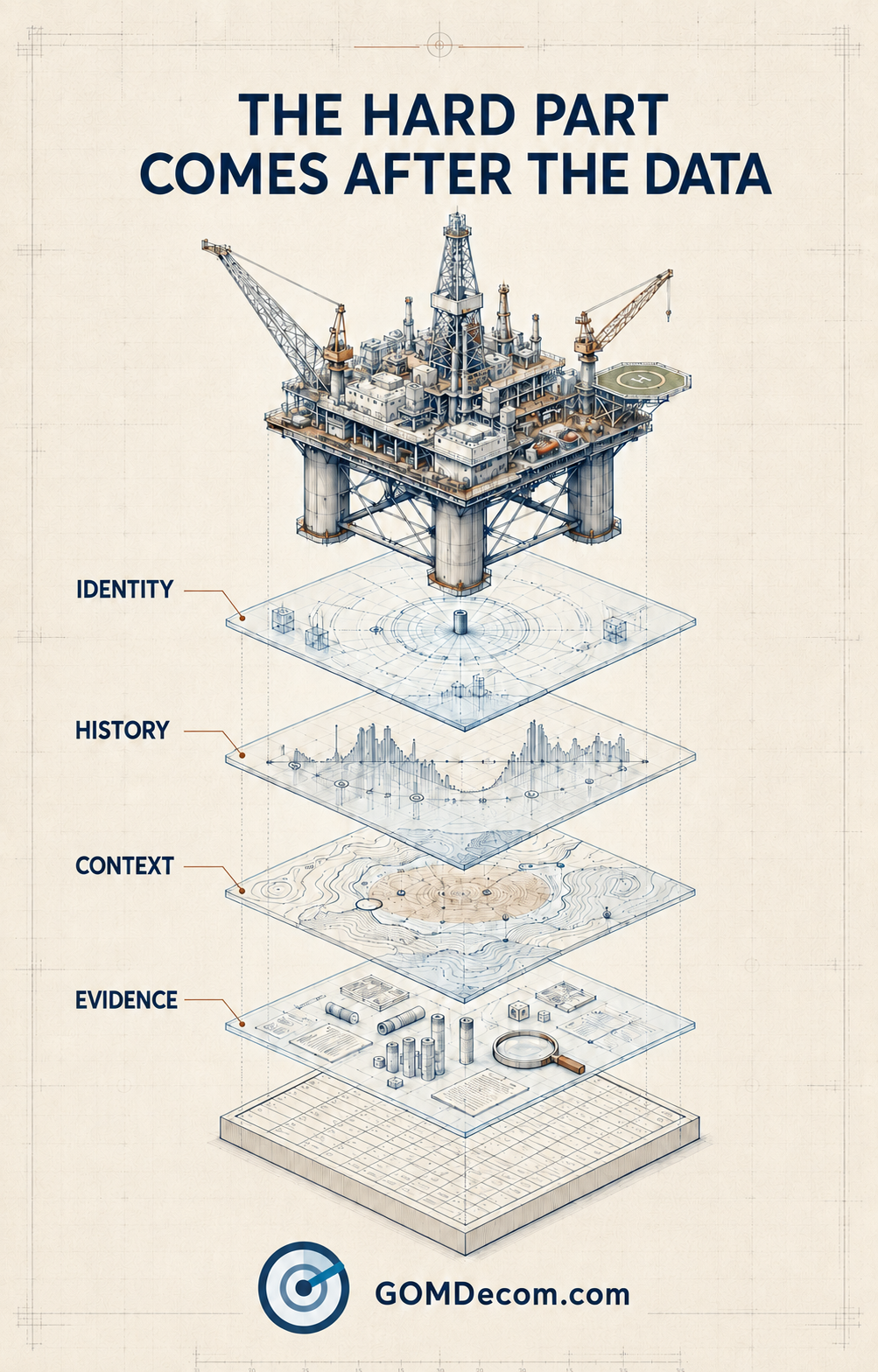
Collection is only the foundation
A raw-data pipeline can be technically impressive. It may process large files, reconcile schemas and refresh on schedule without failure.
Yet the result can still be difficult to use.
Public datasets are usually designed around the needs of the organization publishing them. Different systems may describe the same well, structure, lease, operator or regulatory event using different identifiers and levels of detail. Records can be revised, replaced or published on different schedules. Relationships that matter to an industry professional may exist only indirectly across several tables.
Passing that complexity to the user does not solve the problem. It simply gives the user a faster way to encounter it.
A useful product must add four things to the underlying records: identity, history, context and evidence.
Identity: determine what each record represents
The first challenge is establishing identity.
Names change. Identifiers can be missing or inconsistent. One asset may appear in multiple datasets, while similar names can refer to entirely different entities. Corporate assignments and reorganizations add another layer of complexity.
The goal is not merely to remove duplicate rows. It is to determine whether two records describe the same real-world object—and to preserve uncertainty when the evidence is not strong enough to decide.
This distinction matters. A confident but incorrect match can contaminate every relationship and conclusion built on top of it.
Good entity resolution therefore requires more than approximate text matching. It requires stable identifiers where available, domain-specific rules, supporting attributes and a record of why each match was made.
Identity is not a cleanup step. It is part of the product’s knowledge model.
History: show what changed, not just what exists
A current-state database answers an important question: what does the source report now?
Decision-makers often need a different answer: what changed?
A new filing, ownership update or status transition may be more valuable than a large inventory that has remained unchanged for months. If each refresh overwrites the previous one, that signal disappears.
Preserving history means treating updates as events rather than replacements. The system should be able to explain:
- what the previous value was;
- what the new value is;
- when the change was observed;
- where it appeared; and
- whether it represents a meaningful transition or a routine correction.
This is especially important in regulatory and commercial intelligence. Opportunity often appears in movement: a filing submitted, an approval recorded, work commenced or responsibility transferred. Our guide to reading BSEE’s decommissioning signal chain shows why these transitions matter.
The record matters. The transition often matters more.
Context: preserve the relationships around the record
No offshore asset exists in isolation.
A well belongs to a lease or area. A structure can support several wells. Pipelines connect facilities. Operators change over time. Regulatory activity may relate to one asset while affecting the commercial interpretation of an entire campaign.
Flattening these relationships into a single table may make the data easier to export, but it can remove the context needed to understand it.
A useful product should help the user move between the relevant levels:
record → asset → lease or block → operator → campaign → regulatory history
That does not mean displaying every available field at once. It means preserving the relationships so the product can surface the right context when a decision requires it.
Without those connections, users are left assembling the picture manually across spreadsheets, downloads and browser tabs.
Evidence: separate fact from inference
Once a system begins combining data, it becomes possible to derive useful conclusions. It also becomes easier to overstate what the records prove.
A public filing may show that activity has entered a regulatory process. It does not necessarily show that procurement is open. A lack of reported commencement does not prove that a contract has not been awarded. A cost estimate may indicate regulatory exposure without representing a tender value.
A trustworthy product must make these boundaries visible.
Every material conclusion should distinguish among:
- Source fact: what the published record explicitly states.
- Derived fact: what can be calculated or joined deterministically.
- Inference: what the available evidence suggests.
- Unknown: what the source cannot establish.
This is not just an audit feature. It improves the quality of decisions. Users can act with appropriate confidence because they understand both the conclusion and its limits.
The evidence trail should remain accessible: source, record, observation date and transformation or reasoning. If a result cannot be traced back to its origin, it becomes difficult to verify, correct or trust. That is why GOMDecom’s methodology keeps source evidence, lifecycle classification and commercial interpretation distinct.
The final challenge is deciding what not to show
More detail does not always create more value.
A data product can expose every source field, relationship and calculation and still force the user to perform most of the analytical work. The opposite approach—compressing everything into a score or recommendation—can hide uncertainty and make the result impossible to challenge.
The right interface works in layers.
It begins with the decision-relevant answer: what changed, why it matters and what may require attention. It then allows the user to inspect the supporting context and ultimately reach the source evidence.
This creates progressive depth:
- A clear signal for prioritization.
- Enough context to evaluate it.
- The underlying evidence for verification.
The objective is not to eliminate detail. It is to present detail in the order people need it.
What this means for data and AI products
These lessons extend beyond offshore energy.
AI can summarize records, identify patterns and produce convincing explanations. But it does not remove the need for stable identity, preserved history, explicit relationships or source provenance. In many cases, it makes those foundations more important.
An AI-generated answer is only as reliable as the information model beneath it. If the system has merged the wrong entities, discarded previous states or blurred fact and inference, a fluent explanation will make the problem harder to detect.
The strongest AI products do not simply generate answers. They maintain a path from the answer back to the supporting evidence.
From accessible data to usable intelligence
Public data creates access. A useful product creates understanding.
That requires work after collection: resolving identity, preserving history, connecting context and maintaining an evidence trail. It also requires judgment about how much information to surface and when.
This principle continues to shape GOMDecom. The goal is not merely to place Gulf of Mexico records behind a faster search interface. It is to reduce the work required to understand what those records mean—without hiding where that understanding came from.
Because the hardest part does not end when the data has been collected.
That is where the product begins.
Put this to work
Track the opportunities behind the analysis.
Gulf decommissioning opportunities identified in monitored BSEE records, ranked by commercial priority and refreshed daily. Or validate a single pursuit with a $19 brief.
GOMDecom aggregates public regulatory data for informational purposes. Figures quoted from third parties are attributed in the text; verify against the cited source before acting. Nothing here is legal, investment or procurement advice.